The artificial intelligence landscape in August 2025 has reached an unprecedented pace of innovation, with major breakthroughs transforming how we work, live, and interact with technology. From groundbreaking model releases to massive infrastructure investments, here are the most significant AI developments making headlines worldwide.
GPT-5 Launch Marks New Era in AI Reasoning
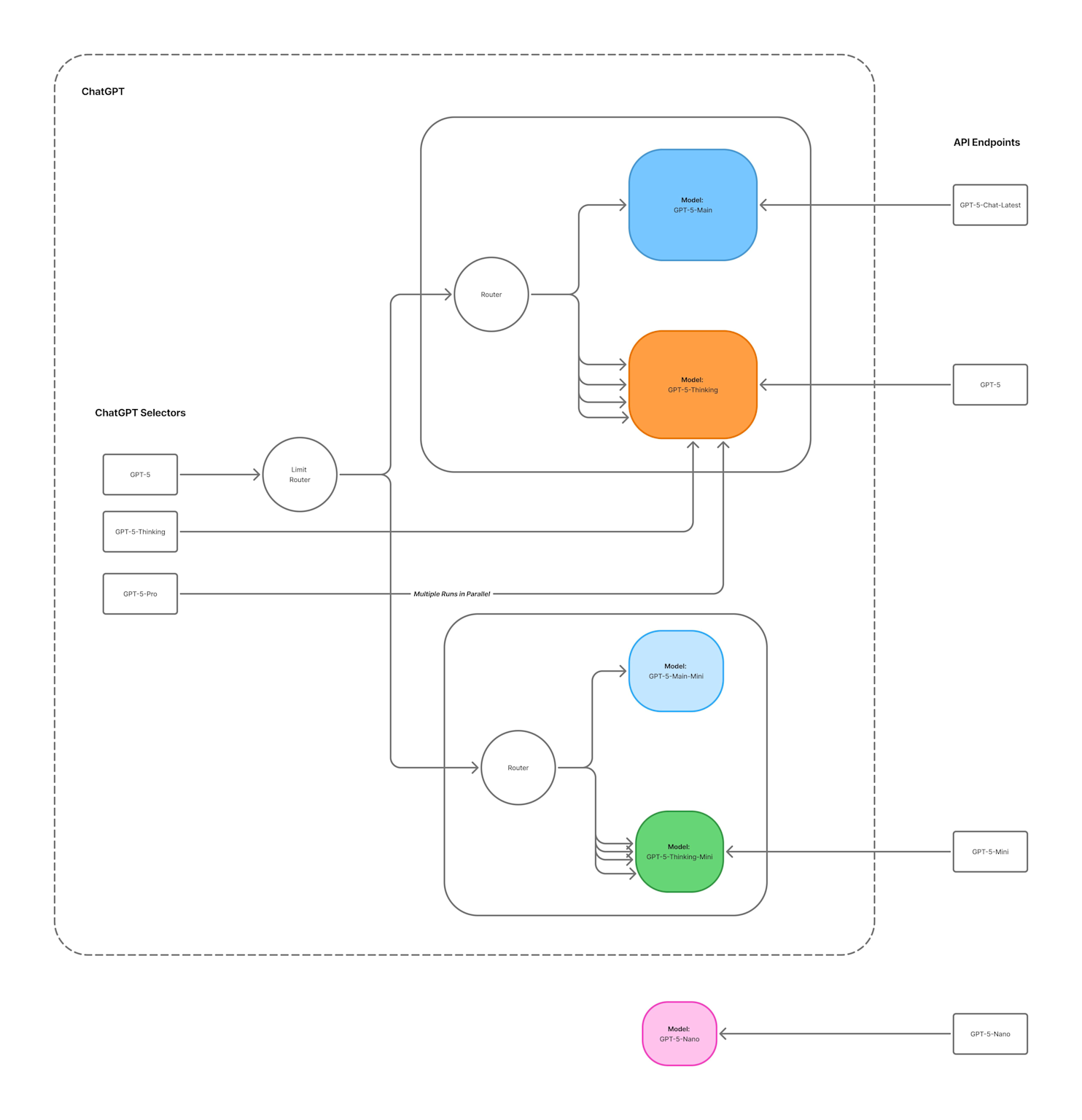
Diagram showing the architecture and routing between various GPT-5 models and API endpoints
OpenAI officially released GPT-5 on August 7, 2025, introducing revolutionary reasoning capabilities that significantly surpass its predecessors. The new model features a 40% improvement in reasoning capabilities compared to GPT-4, along with a “thinking” mode that enables complex multi-step problem solving.
GPT-5 unifies advanced reasoning, multimodal input, and task execution into a single system, eliminating the need to switch between specialized models. The model includes several variants optimized for different use cases: gpt-5, gpt-5-mini, gpt-5-nano, and gpt-5-chat. A built-in routing system automatically decides when to provide instant answers versus engaging deeper reasoning capabilities for complex queries.
However, the release faced unexpected user backlash, with Reddit users criticizing GPT-5’s “flat” tone and reduced creativity compared to GPT-4o. CEO Sam Altman responded by promising to restore GPT-4o access for Plus subscribers and acknowledged underestimating user attachment to the previous model.
AI Hardware Revolution Accelerates
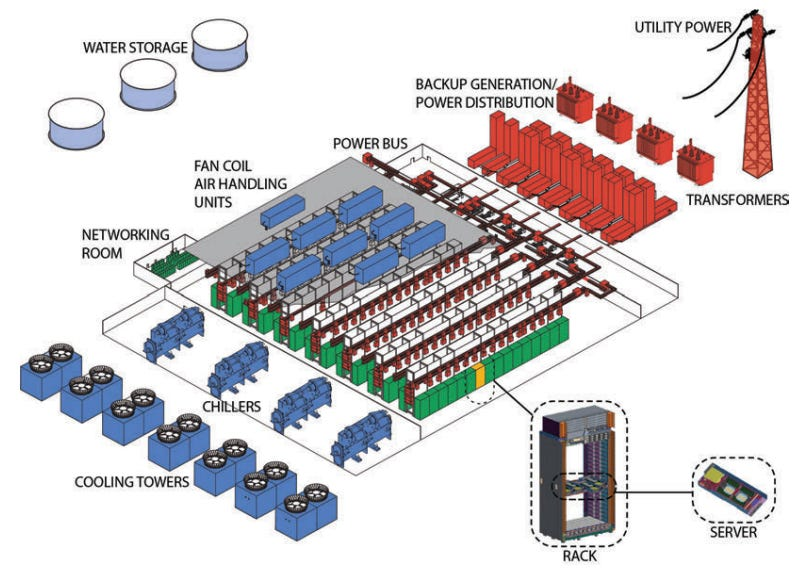
Detailed diagram illustrating the infrastructure components of an AI data center, including power, cooling, and server rack setup
The global AI infrastructure race is intensifying with massive investments across chip development and data center construction. Google announced a $9 billion investment to build advanced AI data centers in Oklahoma, positioning these facilities as major hubs for training large AI models. Meanwhile, North Dakota is set to receive a $3 billion AI-focused data center in Harwood, expected to drive significant economic growth and job creation in the region.

A futuristic humanoid robot in a high-tech lab showcasing AI robotics advancements
NVIDIA continues to dominate the AI chip landscape with its upcoming Blackwell Ultra architecture, designed to optimize next-generation AI functions and support cloud providers in offering high-end AI services. Intel is also making significant strides with its Xeon 6 series processors, offering 30% higher memory speed than competitors and enhanced AI acceleration capabilities.
Quantum Computing Meets AI
The convergence of quantum computing and AI is accelerating in 2025. D-Wave Quantum released an open-source quantum AI toolkit on August 4, 2025, enabling developers to seamlessly integrate quantum computers into modern machine learning architectures. The toolkit provides direct integration between D-Wave’s quantum computers and PyTorch, focusing on training restricted Boltzmann machines (RBMs) for generative AI tasks.
Japan’s new QIDO (Quantum-Integrated Discovery Orchestrator) platform, developed by Mitsui, QSimulate, and Quantinuum, combines quantum algorithms with classical AI to model chemical reactions at unprecedented precision. This breakthrough could significantly accelerate drug discovery and materials science research.
AI Robotics Reaches New Milestones
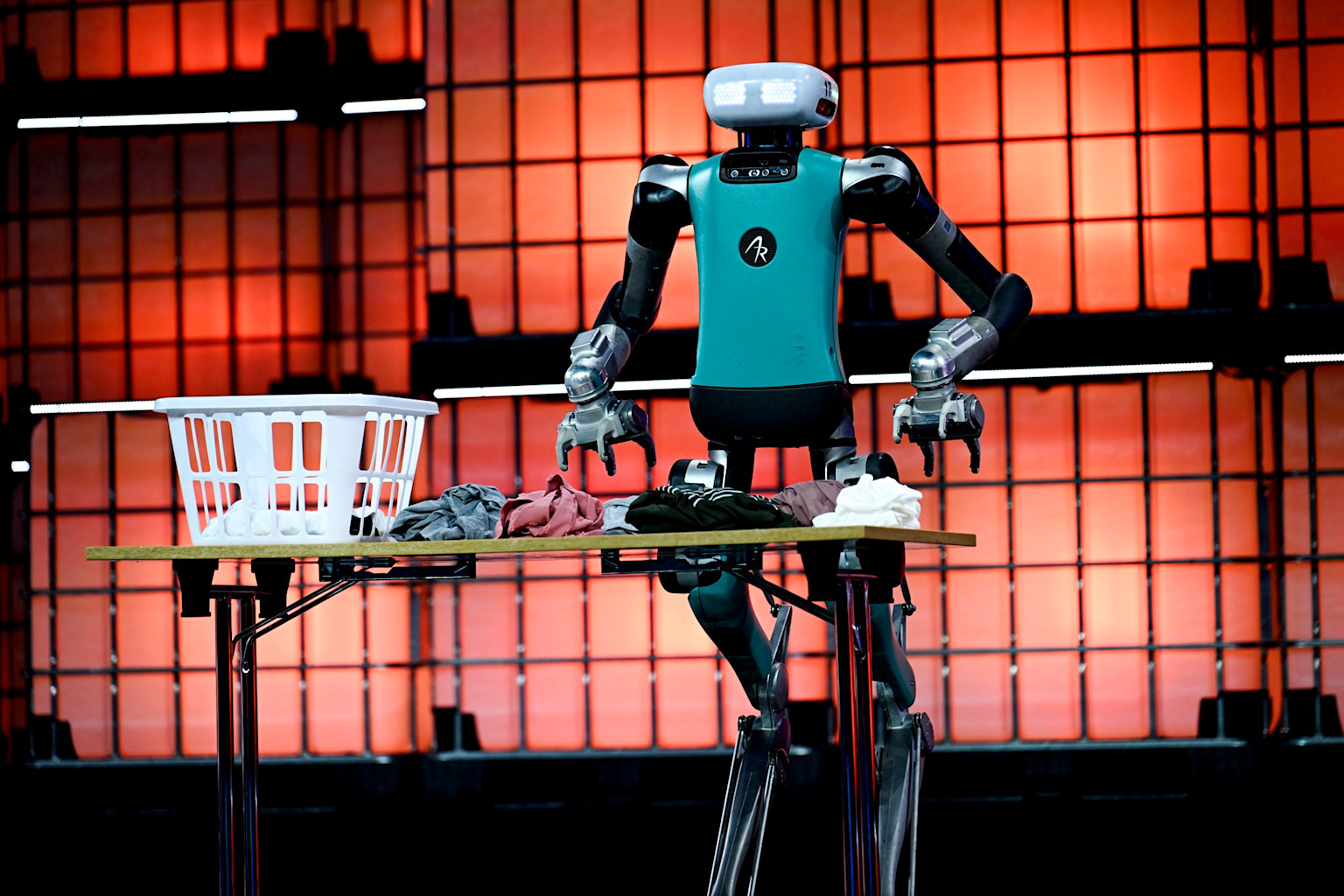
A 2025-era humanoid robot demonstrates folding laundry, showcasing advancements in AI and robotics technology
The robotics industry is experiencing a transformative period with AI-powered humanoid robots becoming increasingly sophisticated. In Q1 2025 alone, robotics startups secured over $2.26 billion in funding, with more than 70% directed toward warehouse and industrial automation. Figure AI is reportedly in talks for a $1.5 billion funding round at a $39.5 billion valuation.
Futuristic cityscape illustrating AI future trends for 2025 with digital brain and advanced technology elements
A groundbreaking development in China saw the creation of an AI-powered robot capable of playing badminton with humans, reacting in real-time to shots and demonstrating unprecedented adaptability. Meanwhile, Stanford University researchers demonstrated an autonomous “virtual lab” where AI agents independently ran experiments to develop new COVID-19 nanobody treatments, with over 90% of AI-proposed drug candidates proving experimentally viable.
Massive Data Center Investment Wave
McKinsey research projects that $5.2 trillion in global investment will be needed for AI data centers by 2030 to meet worldwide demand for AI compute power. This staggering figure reflects projections of 156 gigawatts of AI-related data center capacity demand by 2030, with 125 incremental gigawatts expected between 2025 and 2030.
The investment breakdown shows 60% ($3.1 trillion) flowing to technology developers and chip manufacturers, 25% ($1.3 trillion) to power generation and transmission infrastructure, and 15% ($0.8 trillion) to builders for land, materials, and site development.
Enterprise AI Adoption Gains Momentum

A professional monitoring AI data center servers with organized networking cables and real-time equipment management
Enterprise AI adoption is accelerating despite ongoing challenges. A 2025 survey revealed that appetite for enterprise-wide AI adoption is up 25% compared to 2023. However, 28% of organizations still report using only 3-5 AI applications, suggesting difficulties in expanding from initial testing to broader implementation.
Companies with formal AI strategies report an 80% success rate in AI adoption, compared to just 37% for those without a strategy. The use of generative AI in data engineering has more than doubled over the past year, with 65% of respondents now applying it to backend data functions.
AI Safety and Regulation Developments
Global AI governance frameworks are rapidly evolving. The EU AI Act’s General-Purpose AI Code of Practice was published on July 10, 2025, providing voluntary guidelines for AI model providers to demonstrate compliance with safety, transparency, and copyright obligations. China implemented mandatory labeling rules for AI-generated content, taking effect September 1, 2025.
Canada refreshed its Advisory Council on Artificial Intelligence and launched the Safe and Secure Artificial Intelligence Advisory Group to advise on AI system risks. Six new organizations, including CIBC and Intel Corporation, signed onto Canada’s Voluntary Code of Conduct on AI development.
Scientific Breakthroughs in AI-Driven Research
AI is revolutionizing scientific discovery with remarkable breakthroughs. Profluent Bio used generative AI to create a novel CRISPR enzyme called OpenCRISPR-1 from scratch, representing a completely AI-invented genome-editing tool. UC San Diego researchers developed an AI tool that learns to interpret medical images using only a fraction of traditionally required data.
AI is also accelerating materials discovery, with researchers using AI to design novel battery materials that could lead to longer-lasting, faster-charging, and more sustainable batteries. A universal AI detector now identifies deepfake videos with 98% accuracy across platforms and content types.
Looking Ahead: The AI-Powered Future
As we move through 2025, several trends are becoming clear. AI is transitioning from a tool-based approach to an integral part of business operations and daily life. Agentic AI systems that can autonomously plan and execute complex workflows are rapidly emerging, with Gartner predicting that 33% of enterprise software applications will include agentic AI by 2028.
The convergence of AI with quantum computing, robotics, and advanced hardware is creating unprecedented possibilities for solving complex global challenges. From climate change mitigation to healthcare breakthroughs, AI’s transformative potential is being realized across every sector of the economy.
The year 2025 is proving to be a pivotal moment in AI development, with technological capabilities advancing at an extraordinary pace while regulatory frameworks struggle to keep pace. As these technologies continue to mature and integrate into our daily lives, their impact on society, business, and human potential appears limitless.